Why helical piles beat concrete in the Adirondacks
Poured concrete fights the Adirondack landscape. Helical piles work with it — faster, cleaner, and on the lots concrete can't reach.
A giant screw into solid ground
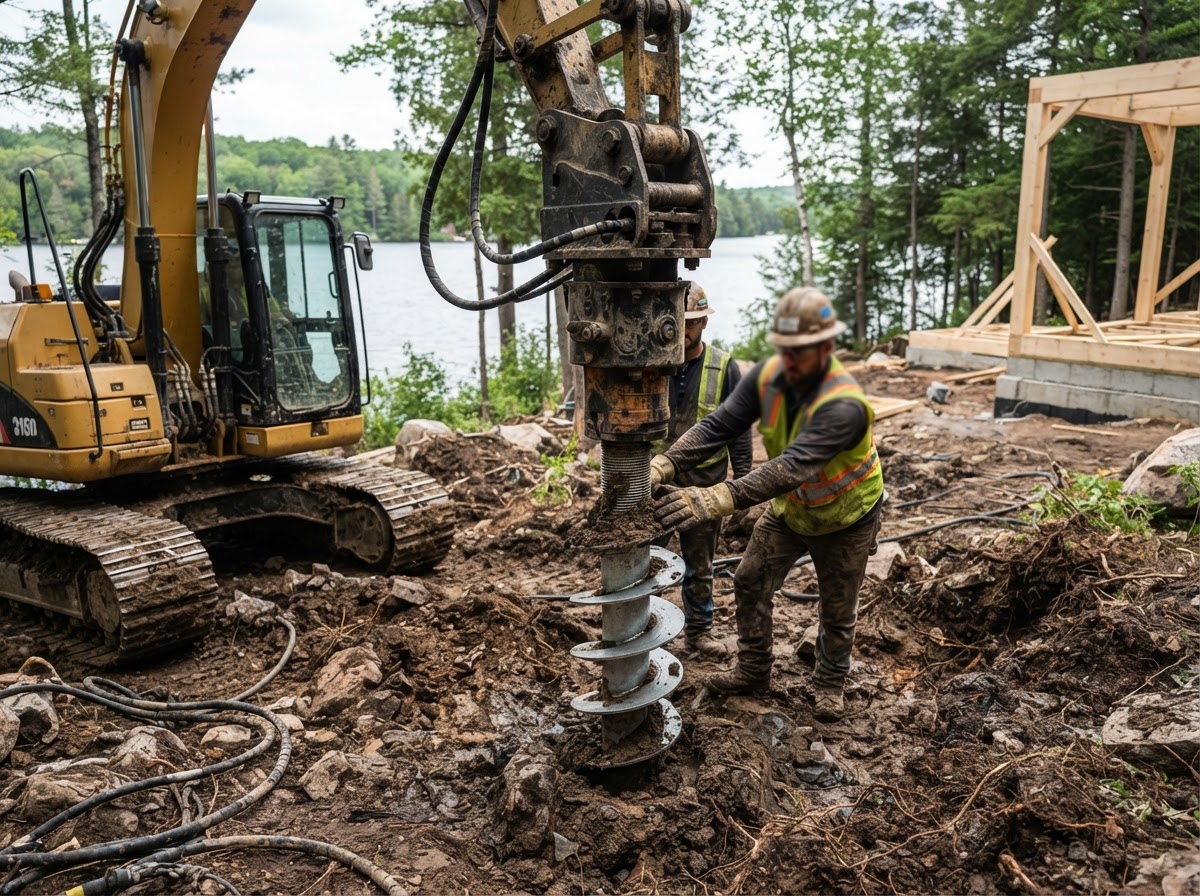
A helical pile is driven into the earth by rotating it, so the helical plates pull it down into load-bearing soil. Torque is measured during installation, which tells us the pile's capacity — engineered strength, verified on your site.
1. Drive to bearing
The pile is screwed down past weak surface soils until it hits solid, load-bearing strata.
2. Verify capacity
Installation torque confirms the pile can carry the designed load.
3. Cut to grade
Piles are trimmed to the right height and capped for your structure.
4. Load immediately
No cure time — the foundation is ready to support the structure the same day.
Side by side
Built for the land, not against it
No cure time
Load the structure the same day it's installed.
Any season
Year-round — including winter and frozen ground.
Goes where concrete can't
Rocky, wet, sloped, and tight-access lots.
Less excavation
Protects trees, yard, and shoreline.
Immediate capacity
Engineered strength, verified on site.
Frost-resistant
Deep bearing below the frost line.
Questions, answered straight
What is a helical pile and how does it work?+
A helical pile is a steel shaft with helical bearing plates welded to it. It's mechanically screwed into the ground — like a giant screw into wood — until it reaches load-bearing soil. The helices pull the pile down and resist uplift, giving you a stable anchor deep below the frost line.
Can you level and stabilize my existing camp without tearing it down?+
Yes. We install piles to solid bearing, then use them to lift and re-level your camp in place. Most stabilization projects don't require demolishing or moving the structure.
Can you work on remote or water-access-only properties?+
Absolutely. Remote and hard-to-reach lake properties are our specialty. Our equipment and methods are suited to lots that trucks and concrete mixers can't easily reach.
Do you work in winter?+
Yes. Helical piles install year-round, including in frozen ground. Winter is often a great time to plan a project so you're ready to build come spring.
How long does installation take?+
Most residential projects take a day or two. You'll get a clear timeline in your quote. Because there's no concrete cure time, the structure can be loaded immediately after install.
Will piles damage my yard, trees, or shoreline?+
Minimal. Helical piles require far less excavation than concrete footings, so there's little disturbance to your land, trees, and shoreline. We're careful to leave the site as we found it.
Are helical piles more expensive than concrete?+
It depends on the site. On easy, truck-accessible lots, concrete can be cheaper. On remote, rocky, wet, sloped, or tight-access lots — most of the Adirondacks — piles are often the more cost-effective and faster option once you factor in access, excavation, and cure time.
Do I need a permit, and can you help with it?+
Most foundation work requires a permit, and requirements vary by town and county. We can help you understand what's needed for your project and work with your local building department.
Still have questions?
Call 315-404-9641Ready to put your project on solid ground?
Tell us about your camp, cabin, dock, or deck. We'll recommend the right approach and give you an honest quote.
Get Your Free Estimate
Tell us about your project. Seasonal and out-of-area owners are welcome — many of our camp owners don't live nearby, and that's no problem.